

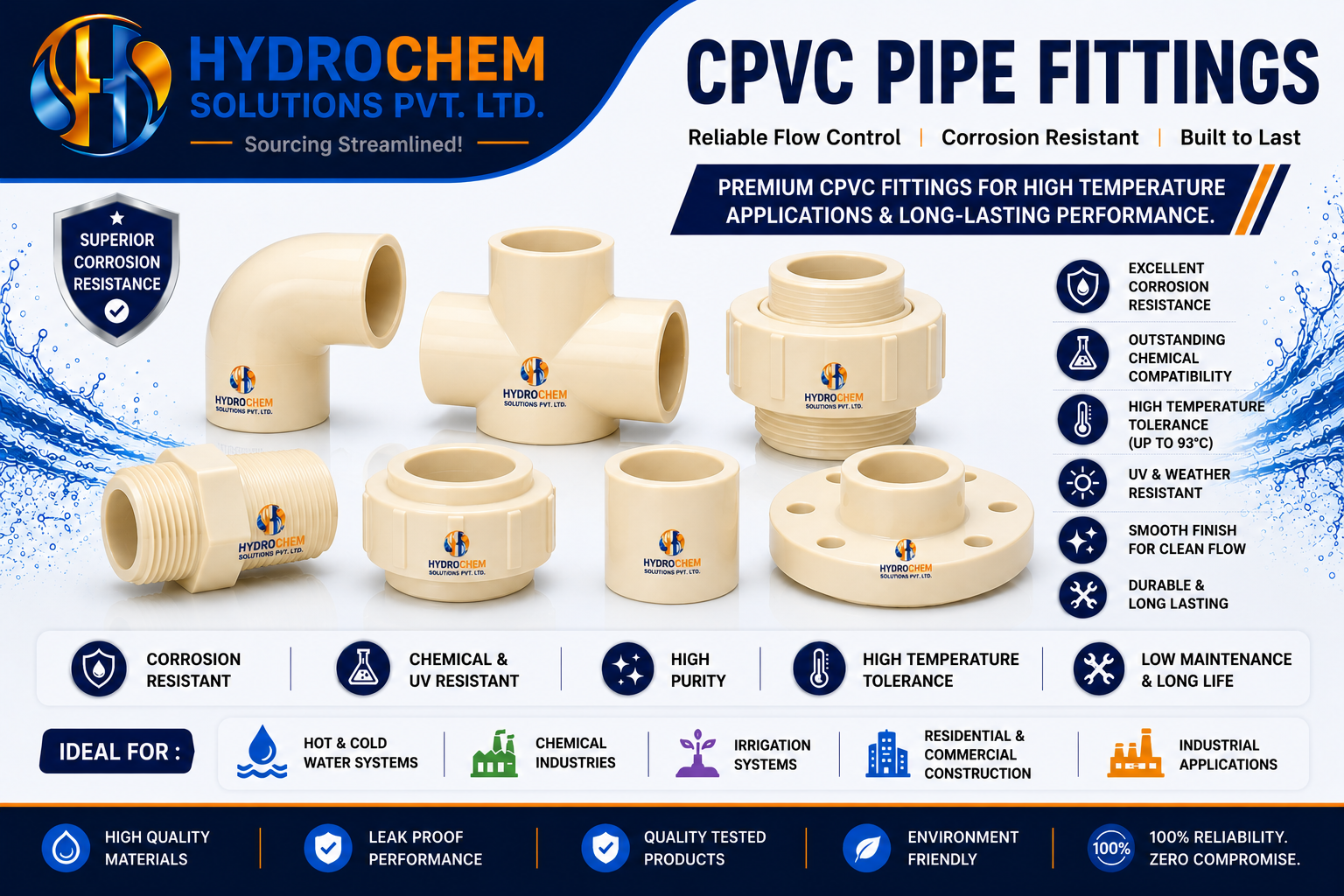
CPVC Pipe Fittings
CPVC (Chlorinated Polyvinyl Chloride) pipe fittings are part of a thermoplastic piping system, which is widely used in modern residential and light commercial systems. These components are engineered for transporting both hot and cold potable water, offering a corrosion-resistant, lightweight alternative to metal pipes. The brand produces CPVC products designed to meet or exceed industry standards for safety, flow efficiency, and installation ease.
CPVC material is created by chlorinating PVC resin, which enhances its thermal and mechanical properties. This allows CPVC to withstand higher temperatures—up to 200°F (93°C)—compared to standard PVC, making it ideal for hot water distribution through straight pipes in various diameters (typically ½ inch to 4 inches), along with elbows, tees, couplings, adapters, and other essential fittings needed for complete system assembly. These products are commonly used in single-family homes, multi-unit buildings, and retrofit projects where long-term reliability and code compliance are critical. Especially popular in regions prone to acidic water or where galvanized steel pipes have historically failed due to rust and scaling.
Feature of CPVC Pipe Fittings
- Material Composition
- Made from Chlorinated Polyvinyl Chloride (CPVC), a thermoplastic material.
- Higher chlorine content than PVC, giving it improved temperature and chemical resistance.
- Temperature Resistance
- Cpvc pipe fitting can handle the hot and cold water applications.
- These typically withstand temperatures up to 90–95°C (194–203°F) continuously.
- These are suitable for industrial and residential hot water systems.
- Corrosion and Chemical Resistance
- Cpvc pipe fitting is resistant to corrosion, rust, and scaling, unlike metal fittings.
- Cpvc pipe fittings are compatible with a wide range of chemicals, including acids and alkalis, making it ideal for industrial piping.
- Strength and Durability
- CPVC pipe fittings are strong and impact-resistant.
- These can withstand high water pressure, usually up to 10–20 bars depending on size and rating.
- The durability for long-term use (20–50 years in ideal conditions).
- Lightweight
- CPVC pipe fittings are much lighter than metal fittings, making handling and installation easier to install..
- They reduce transportation and labor costs.
- Smooth Inner Surface
- Low friction coefficient for smooth water flow.
- Reduces pressure drops and minimizes scaling.
- Easy Installation
- Cpvc Pipe fitting can be joined using solvent cement (glue) or mechanical connections.
- There is no welding or threading required, unlike metal pipes.
- Quick to assemble, saving time and cost.
- Non-Toxic
- Safe for potable (drinking) water.
- Does not leach harmful chemicals into water.
- Fire Retardant
- CPVC Pipe fittings are self-extinguishing.
- Do not spread flames easily in case of fire.
- Versatility
- Available in a variety of shapes and sizes: elbows, tees, couplings, reducers, sockets, etc.
- These can be used for residential, commercial, chemical, and industrial piping systems.
Benefits of CPVC Pipe Fittings
- High Temperature Resistance
Cpvc pipe fitting can handle the hot water up to 82°C continuously and the short-term exposure up to 95°C, unlike UPVC
- Excellent Corrosion Resistance
These are resistant to acids, alkalis, salts, and most of the chemicals, preventing rust, scaling, and corrosion
- Smooth Internal Surface
CPVC pipe fitting reduces the friction of losses, improves flow efficiency, and prevents the scaling inside pipes.
- Lightweight and Easy to Install
These are easier to handle and transportation which is compared to metal fittings, reducing labor and installation cost.
- Leak-Proof Joints
Solvent cement and threaded connections provide permanent, leak-proof joints.
- Durable and Long-Lasting
Service life of 25–50 years under proper operating conditions.
- Cost-Effective
Lower initial cost than metals and minimal maintenance over the life of the system.
- Chemical Compatibility
These are suitable for industrial, domestic, and chemical piping systems.
- UV Resistance (with stabilized grade)
Can be used in outdoor applications with UV-stabilized CPVC.
- Non-Conductive and Safe
Electrically insulating, suitable for water systems and chemical lines without risk of electrical hazards.